
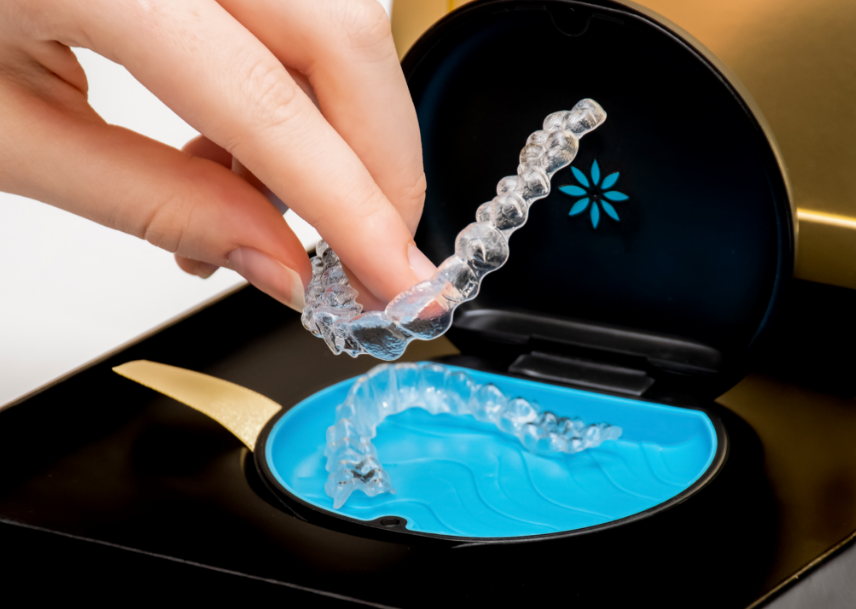
More adults than ever are improving their smiles with Invisalign — and many of them already have dental restorations such as crowns, veneers, or bridges. If you’re one of them, you may wonder whether clear aligners are still an option. The good news is that Invisalign can often be used safely and effectively alongside certain restorations, but every case needs to be carefully evaluated to ensure the teeth and bite remain healthy during treatment.
Understanding how Invisalign interacts with crowns, bridges, and veneers can help you set realistic expectations and have an informed conversation with your dentist.
Getting Invisalign With Dental Crowns
In many cases, Invisalign can be used on teeth that have crowns. Since clear aligners move teeth through gentle, continuous pressure, the underlying tooth and bone — not just the crown — are what respond to movement.
However, your dentist will pay close attention to:
• The condition and stability of the crowned tooth
• How securely the crown is bonded
• Whether attachments can be placed safely on the crown
In some situations, the dentist may avoid placing aligner attachments directly on a crown to prevent damage. If the crown is older or weakened, it may need to be replaced either before or after orthodontic treatment.
With proper planning and monitoring, many patients with crowns can successfully — and comfortably — undergo Invisalign treatment.
Getting Invisalign With Veneers
Veneers are bonded to the front surfaces of teeth, which can make Invisalign more complex but not always impossible. Since veneers are cosmetic restorations, your dentist will want to avoid placing too much pressure on them or causing them to loosen.
Your dentist will carefully evaluate:
• How many teeth have veneers
• Whether the veneers are structurally strong
• How much tooth movement is needed
• Whether attachments are necessary in those areas
Minor movement or cosmetic alignment may still be achievable, especially if the veneers are secure and only small adjustments are required. However, cases involving significant tooth movement may carry higher risks.
Your dentist will help determine whether Invisalign is appropriate — or whether it is safer to replace veneers after alignment instead.
Getting Invisalign With Dental Bridges
Dental bridges are different from crowns and veneers because they connect two or more teeth together. Since Invisalign works by moving teeth individually, a bridge cannot move in the same way.
For this reason, Invisalign is typically more limited when bridges are present.
Your dentist will assess:
• Which teeth are part of the bridge
• Whether surrounding teeth can move independently
• Whether movement near the bridge would affect its stability
In some cases, Invisalign can still be used to move teeth that are not connected to the bridge. In others, orthodontic treatment may be planned around the restoration or postponed until replacement becomes necessary.
The goal is always to avoid damaging the bridge or placing stress on supporting teeth.
Why an Individualized Consultation Matters
No two smiles are alike — and that’s especially true when dental restorations are involved. What works for one patient with crowns or veneers may not be appropriate for another.
A thorough exam, imaging, and bite evaluation allow your dentist to determine:
• Which teeth can safely move
• Whether modifications to treatment are needed
• How to protect existing restorations
• Whether alternative options may be better
Your dentist will work with you to create a plan that supports both your alignment goals and your long-term oral health.
With the right approach, many patients with restorations can still enjoy the benefits of a straighter, more harmonious smile.
About the Practice
Dr. Broaddus and Dr. Laffita of Family & Implant Dentistry of Stuart provides comprehensive family and cosmetic dentistry with a strong focus on personalized care and long-term oral health. Our experienced dental team offers Invisalign and other orthodontic solutions tailored to each patient’s needs, including those with crowns, veneers, and bridges. Through careful evaluation, thoughtful treatment planning, and ongoing monitoring, we help patients achieve straighter, healthier smiles in a comfortable and supportive environment.
Call us at (772) 286-3088 or request an appointment online.